
Introduction: The Silent Safety Net
 Saying a final goodbye to a loved one who served is a moment of profound emotional weight, often compounded by a sudden, heavy financial burden. With the average cost of a funeral in America now ranging between $7,000 and $10,000, the logistical realities of a dignified farewell can feel overwhelming. While most veterans are intimately familiar with their healthcare options or the GI Bill, the “silent safety net” of VA burial benefits often remains an untapped resource, misunderstood or overlooked until the moment the fog of grief is at its thickest.
 It is a common misconception that these benefits are a simple, one-size-fits-all “funeral check.” In reality, they represent a nuanced system of honor designed to reflect the nature of a veteran’s service and the specific circumstances of their passing. This is not merely an administrative reimbursement; it is a final commitment from a grateful nation.
As a veterans advocate, I have seen too many families miss out on earned support because they didn’t understand the mechanics of the system. The following guide translates bureaucratic “gov-speak” into five impactful truths that every veteran and survivor should know to ensure that no benefit—and no honor—is left on the table.
1. The “Debt of Honor” Adjustment (The Service-Connection Multiplier)
In the eyes of the VA, not all deaths are treated the same from a financial perspective. The most significant pivot point in the burial system is the distinction between service-connected and non-service-connected deaths. When a veteran passes away due to a disability incurred during military service, the VA triggers what I call the “Debt of Honor” adjustment—a significantly higher rate of compensation to acknowledge the government’s heightened responsibility toward those who gave their lives as a direct result of their duty.
 Current Burial Allowance Rates:
Service-Connected Deaths: Up to **2,000** for deaths occurring on or after September 11, 2001 (1,500 if prior to that date).
Non-Service-Connected Deaths: Up to $978 for burial and funeral expenses for deaths on or after October 1, 2024.
This multiplier serves as a critical buffer, and for service-connected deaths, it often opens the door for additional reimbursements regarding the cost of transporting the deceased to a VA national cemetery.
For families, this distinction is the difference between a helpful stipend and a major financial cushion.
2. Safeguarding Career Vets: Benefits for the “Entitled but Underserved”
There is a specific subgroup of “Career Vets”—those who served 20 or more years—who often assume they are ineligible for VA burial benefits because they don’t receive a monthly VA disability check. This confusion arises because many retirees choose to receive their full military retirement pay rather than reducing it to receive VA compensation.
It is a vital strategic insight to know that the VA protects these veterans. If a veteran was entitled to receive compensation but chose the retirement pay path for financial reasons, their eligibility for burial benefits remains fully intact. This ensures that those who dedicated their lives to a career in uniform are not penalized for their financial choices at the end of their journey. Their right to final honors is preserved, regardless of which “payroll” they were on.
3. Choice in Final Resting: The Private Plot vs. National Honors
When planning a burial, families face a choice that significantly impacts their out-of-pocket costs. The VA provides distinct support mechanisms depending on whether the veteran is laid to rest in a national cemetery or a private one.
The National Cemetery Advantage: Choosing a VA national cemetery is, in many ways, the ultimate benefit. The plot and the interment are provided at no cost to the family—a benefit whose market value far exceeds any cash stipend.
The Private Plot Allowance: For families who prefer a local or private cemetery, the VA offers a $978 plot-interment allowance (for deaths on or after October 1, 2024). This is provided in addition to the standard burial and funeral expense allowance, provided the veteran is not buried in a national cemetery.
By providing these two paths, the VA lowers the barrier to entry for prestigious burials, allowing families to prioritize the veteran’s legacy and personal wishes over the immediate pressure of a cemetery invoice.
4. Knowing the Bounds: Who These Benefits Cannot Reach
While the VA’s net of support is broad, it is not universal. To avoid unexpected financial gaps during an already difficult time, families must understand three specific exclusions.
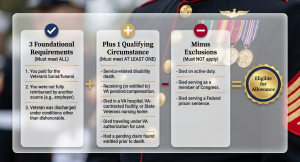 These are groups the VA burial allowance program explicitly cannot reach:
Active Duty Service Members: While this may seem jarring, it is because active duty deaths are covered by Department of Defense (DoD) programs, which are generally more comprehensive and immediate than VA burial allowances.
Members of Congress: Individuals serving in Congress at the time of death are ineligible for these specific VA funds.
Federal Prisoners: Benefits are not paid if the deceased was serving a Federal prison sentence at the time of death.
Understanding these bounds is essential for a complete financial strategy, ensuring survivors know exactly which agency—whether the VA or the DoD—to turn to for support.
5. Navigating the Fog of Grief: The “Statement of Account” Safety Valve
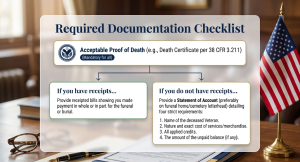 Administrative precision is often the last thing on a survivor’s mind during the “fog of grief.” Recognizing this, the VA provides a bureaucratic safety valve for documentation. While the standard requirement is a set of “receipted bills” to prove payment, the VA allows for more flexibility to keep the process moving.
Under 38 CFR 3.211, the VA requires acceptable proof of death (typically a death certificate). However, when it comes to costs, you can utilize a “Statement of Account” rather than waiting for final receipts. This allows you to file VA Form 21P-530EZ more quickly, avoiding the standard claim backlog.
Statement of Account Requirements: The VA prefers this document to be on the funeral director’s or cemetery owner’s official letterhead. It must include:
The name of the deceased Veteran.
The specific nature and cost of services and merchandise.
All credits applied to the account.
Your Next Steps: A Tactical Checklist
 If you are ready to apply for a burial allowance or are assisting a family in doing so, follow this tactical roadmap:
Method 1: Apply Online. The fastest way to submit your application is directly through the official VA website.
Method 2: Apply by Mail. Use VA Form 21P-530EZ (Application for Burial Allowance).
Mailing Address: Department of Veterans Affairs, Pension Intake Center, PO Box 5365, Janesville, WI 53547-5365.
Method 3: Accredited Representative. Work with a Veterans Service Officer (VSO) to ensure your evidence is “Fully Developed” before submission.
Method 4: In-Person. Visit your local VA regional benefit office to turn in your application directly.
 Pro-Tip from the Strategist: Always include a copy of the Veteran’s DD214 and the death certificate (per 38 CFR 3.211) with your initial filing to prevent “Evidence Requests” that can delay your payment by weeks or months.
The remaining unpaid balance.
Conclusion: A Legacy of Care
VA burial benefits are more than mere fiscal reimbursements; they are a final act of gratitude. They serve as a lasting statement from the government that a veteran’s service is honored from the day they take the oath until the day they are laid to rest. By mastering these five truths, we can navigate one of life’s most difficult transitions with clarity and ensure our families are prepared to access the legacy of care we have earned.
Have you sat down with your loved ones to ensure they have the tools—and the forms—necessary to claim these final honors?