
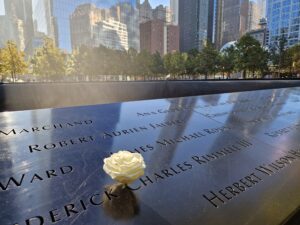
Today marks the 25th anniversary of the September 11 attacks on the World Trade Center. This day is a somber reminder that a quarter century ago, we faced the deadliest terrorist attack on U.S. soil, resulting in 2,977 fatalities. Twenty-five years later, the grief we feel as a nation still lingers and weighs on our hearts, as the events of that day changed our history forever.
But grief and remembrance do not exist on a single date on the calendar. For many families, honoring a loved one is a continuing act. In the case of those lost on September 11, an endearing ritual of remembrance has grown into a community effort.
At the National September 11 Memorial & Museum, one such tradition ensures that the lives lost on September 11, 2001, as well as those lost in the 1993 World Trade Center bombing, continue to be remembered throughout the year. Each morning, staff places a single white rose beside the name of each person whose birthday falls on that day. A photograph of the rose beside their loved one’s name is also shared with the family. When family members are present on their loved one’s birthday, they may place the rose themselves.
The tradition began as a way to ensure that those memorialized would be remembered as individuals, rather than simply as names engraved together at the site. By honoring their birthdays, the ritual celebrates the lives they were living before they were abruptly taken. For many victims’ families, the tradition has offered an opportunity to celebrate the person they loved rather than focus solely on the way they lost them.
The white roses are donated by Michael Collarone, owner of Mikey’s Flowers, a local florist who was trained as an EMT and rushed to aid victims during the attacks. Each week, he personally selects and prepares the white roses before donating them to the memorial.
Collarone’s connection to September 11 runs deep. He volunteered his EMT skills during the recovery and cleanup efforts, documenting some of that work in photographs that would later become part of the museum’s collection. His flowers were also used to adorn some of the earliest makeshift memorials that appeared throughout New York City in the days following the attacks. More than two decades later, his flowers continue to serve the same quiet purpose: honoring the lives behind the names.
Because the birthdays of those memorialized span the calendar, birthday remembrances take place throughout the year. The simple placement of a single white rose transforms a name engraved in bronze into a personal story; a reminder that each person honored there was someone’s loved one. The Birthday Roses tradition began in 2013 and has since become an enduring part of remembrance at the memorial.
More than a decade later, the Birthday Roses tradition is still going strong, and it has inspired others. Roses of different colors can sometimes be found among the names at the memorial, placed not by staff but by visitors and victims’ families. The roses have also become a point of connection between families, creating opportunities to share stories, offer comfort, and remember the people behind the names. They are a community united by tragedy, but also one that has found connection and compassion through tremendous adversity.
Grief is experienced differently by each of us, and throughout our lives we find our own ways of processing loss. Memorial rituals can become part of that process. Lighting a candle, visiting a gravesite, leaving flowers, observing an anniversary, or simply speaking someone’s name gives us a way to express something that can otherwise be difficult to put into words. These acts do not erase grief, but they can give it somewhere to go.
Perhaps that is what makes the white roses especially poignant. Each rose marks a birthday: a day associated not with death, but with life. For a moment, attention moves away from September 11, 2001, and toward another date entirely: the day one individual entered the world.
The names engraved at the memorial belong to people whose lives were in motion before they were suddenly taken. They had families, friendships, routines, celebrations, and stories that extended far beyond the circumstances of their deaths. The birthday roses offer their loved ones, and all who visit, a small ritual through which those lives can continue to be acknowledged.
Grief does not ask us to stop loving or remembering someone simply because they are gone. Instead, over time, we may discover new ways to carry their memory with us.