
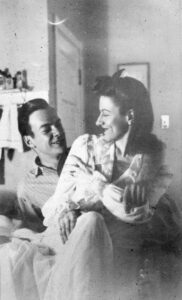
 A letter captures a moment in time.
On October 17, 1946, Richard Feynman sat down and wrote to his late wife, Arline, sixteen months after her death. The letter is tender, grief-stricken, funny, and deeply personal; a glimpse of a young man trying to understand what it meant to continue loving someone who was no longer there.
At the time, Feynman was only 28 years old. Much of the life for which he would later become famous still lay ahead of him.
He had already lived through extraordinary circumstances. Born in New York City in 1918 and raised in Far Rockaway, Queens, Feynman studied at the Massachusetts Institute of Technology and later earned his doctorate at Princeton. During the Second World War, he joined the Manhattan Project and worked at Los Alamos, where some of the era’s most consequential scientific work was taking place.
But alongside that history was another, far more private story.
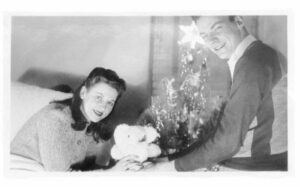
Feynman had known Arline Greenbaum since his youth. They married in 1942 while she was seriously ill with tuberculosis. Their marriage unfolded under turbulent events, with periods of separation caused by her treatment and his work during the war.
Arline died in 1945, at the age of 25.
More than a year later, Feynman found words to his loss and felt compelled to write to her.
“I adore you, sweetheart,” he wrote.
Elsewhere in the letter, he struggles openly with the contradiction of grief: how someone can be gone and yet remain emotionally present. He writes of still wanting to comfort her, care for her, and share ordinary parts of their lives they could have had ahead in their marriage.
The letter closes with one of its most memorable lines:
“P.S. Please excuse my not mailing this—but I don’t know your new address.”
The ending sentiment a rather poignant summary of his displacement of emotions since Arline’s passing.
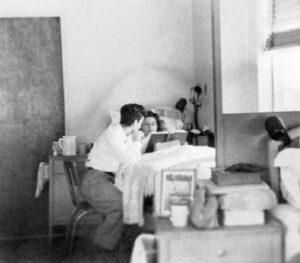
It is tempting, when reading such a powerful letter, to allow that moment to define the rest of Feynman’s story. But October 17, 1946 was exactly that: a moment. His life continued.
In the years that followed, Feynman became one of the most influential physicists of the twentieth century. His work in quantum electrodynamics helped transform the way physicists understood the interactions of light and matter. He became especially associated with what are now known as Feynman diagrams, visual tools used to represent interactions between subatomic particles.
In 1965, Feynman shared the Nobel Prize in Physics with Julian Schwinger and Shin’ichirō Tomonaga for their work in quantum electrodynamics.
He also became renowned as a teacher. His lectures at the California Institute of Technology were collected into The Feynman Lectures on Physics, a work that continues to influence students, scientists, and curious readers decades later.
Later in life, Feynman entered the public eye again as a member of the commission investigating the 1986 Challenger space shuttle disaster. His direct, practical demonstration of how cold temperatures affected the shuttle’s O-ring material became one of the investigation’s defining moments.
Yet even a life filled with scientific achievement was more than its accomplishments. Feynman married again after Arline’s death, and later married Gweneth Howarth, with whom he built a family. They had two children, Carl and Michelle. Feynman and Gweneth shared the later decades of his life, and today they are interred together at Mountain View Cemetery.
Seeing the bigger picture of his life makes the October 17th letter have levels and dimension.
It is not the final word on Feynman’s life, or on love, or on the relationships that shaped him. It is instead a preserved fragment of one tender day: a young widower writing into absence, before so much of his future had yet unfolded.
Cemeteries often give us only the briefest outlines of a person: a name, a birth date, a death date, perhaps an inscription. Lives are made of far more than those markers. They are made of choices, mistakes, relationships and even the mundane. Sometimes a surviving letter allows us to stop at one of those moments and see a person not as history remembers them, but as they were then. Often not, we do not see the value of what’s important until it is gone.
On October 17, 1946, Richard Feynman was not yet the Nobel Prize-winning physicist, celebrated lecturer, public intellectual or cultural figure he would become. He was grieving a young man who missed his wife, and through the letter he left behind, that moment remains.
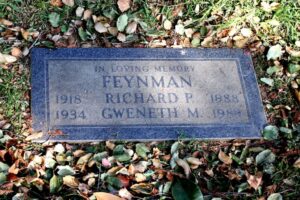
Richard P. Feynman is interred at Mountain View Cemetery alongside his third wife, Gweneth, with whom he had two children and made his home in Altadena.
Read Richard Feynman’s full October 17, 1946 letter to Arline here.
(images via sothebys.com)